July 2008


Devotional Thoughts &Life in General31 Jul 2008 08:58 am

There are a number of places where the Bible commends (even commands) hospitality:

  • Now in the neighborhood of that place were lands belonging to the chief man of the island, named Publius, who received us and entertained us hospitably for three days.  Acts 28.7
  • Contribute to the needs of the saints and seek to show hospitality.  Romans 12.13
  • Therefore an overseer must be above reproach, the husband of one wife, sober-minded, self-controlled, respectable, hospitable, able to teach…  I Timothy 3.2
  • Let a widow be enrolled [in the church's widow support program] if she … has shown hospitality…  I Timothy 5.9-10
  • But [a pastor must be]  hospitable, a lover of good, self-controlled, upright, holy, and disciplined.  Titus 1.8
  • Do not neglect to show hospitality to strangers, for thereby some have entertained angels unawares.  Hebrews 13.2
  • Show hospitality to one another without grumbling. As each has received a gift, use it to serve one another, as good stewards of God’s varied grace.  I Peter 4.9-11

The Greek word translated as variants of “hospitality” is a compound word formed from the words “stranger” and “love.”  It is the idea of showing compassion on strangers.  In the New Testament, we find that such compassion is not only for strangers, but also for those within the community of faith.  Hence, Galatians 6.10: “So then, as we have opportunity, let us do good to everyone, and especially to those who are of the household of faith.”

This is a preface to a heartfelt “thank you” that I owe to some friends who showed this hospitality to me.  For three weeks, this family provided lodging and meals for me – and not begrudgingly!  I enjoyed both the quality of the meals and their fellowship around them.  They provided me part-time work to do and paid me generously for that work.  They provided significant transportation help as well.  Even beyond all the material forms of hospitality, I was blessed by the spiritual side of their generosity.  From family devotions to baseball games to meals to shopping trips to playing in the backyard – throughout my stay with them, I really felt like part of the family!  I am grateful to the Lord for putting them in my path to provide during a pressure-point of his will.

My sincerest thanks to Mike and Mandy, and Noah, Ben and Sammy!  As often as we are able, may we follow them as they follow Christ!

Devotional Thoughts &Theology31 Jul 2008 12:05 am

Paul’s discussions on meat sacrificed to idols and observance of special days (Rom. 14; I Cor. 8-10) have been rolling around in my head for a while.  There’s some good fodder for contemplation in those chapters: there will always be differences between the ways that godly believers apply Scriptures.  Some people have “higher standards” – others have “more liberty.”  This came to the forefront of my mind when a friend recently asked for my thoughts on those passages.  I dug up an old email I had sent; here is that note (slightly updated).

In Rom. 14 and I Cor. 8-10, Paul doesn’t seem to think that either group (“higher standards” or “more liberty”) should try to change the other – his instruction points toward getting along in love, not “helping them understand their freedom” or “waiting for them to learn more Scripture and realize why they should quit doing that.”  I’ve thought a few times about the current popular view of that passage and the resulting application, and I believe that the definition of skandalon (translated “stumbling-block” or “offense”) is key to understanding these chapters rightly.

My experience is that the common understanding of I Cor. 8-10 (and Rom. 14) is “you shouldn’t do anything that your brother would consider sinful, because Paul says don’t offend your brother.”  Is “doing anything that my brother would consider sinful” the definition of stumbling-block?  No.  From what I can tell from Paul’s use of skandalon in the passage, its context-specific meaning here seems to be “causing someone to actively violate his conscience by following your example.”  In the future, I hope to chase that word through the NT and see how Paul and others used it in different contexts, but if this understanding is correct, then the correct application of the passage is significantly different from the common application.

If, as I suggest, stumbling-block involves a conscience-violating action, then the type of preaching-teaching that says “live by the highest standard possible so that your choices don’t violate someone else’s conscience” becomes a man-made regulation, not the outflow of correctly understanding the Scripture.  When skandalon is defined as an action that violates the active follower’s conscience, then it’s actually fine for me live in the bounds of Scripture and my conscience in any area, as no one “weaker” follows my example and violates his own conscience.

This understanding seems, in my view, to explain why Paul chose the word “weak” to describe the offense-prone believer.  He’s not saying that higher standards make you weak; he’s saying that the inability to strongly stand by your conscience and conviction makes you weak.  (Please pardon the following examples if you must – they are deliberately chosen and worded to avoid conflict.)  If a lady has dress standards that don’t permit her to wear pants and a strong character, then other ladies can wear pants around her without causing offense because she’s not weak (even though her standards are higher than average).  On the other hand, a Christian with a conviction against television who lacks strength of character would be prone to suppress his conscience and watch TV in another believer’s house – he is weak, he violated his conscience by watching TV and the other believer set a stumbling-block (though perhaps unwittingly and innocently).  Of course, the over-riding liberty-limiter is not “how well I know my brother’s strength and how much I think I can do,” but rather, love that is fervently unwilling to cause an offense (unknowingly or not) to a brother.

I’m also discussing this with a few seminary friends and will probably post more as I come up with more questions and refine my understanding.

For now, though, I’d love to get some feedback on these thoughts – please feel free to comment below or send me an email!

Devotional Thoughts &Life in General28 Jul 2008 05:01 pm

One of my best friends is moving tomorrow.  I’ve known Andy for 5 years and he has been a faithful friend during the hardest and happiest moments of that time.  I’m not sad about his departure – he’ll be taking an assistant pastorate in a church and following the Lord’s leading into the vocation for which he’s prepared.

Andy’s parting words to me (on this and on other occasions) were these: “Stay right.”  That’s good advice – and good to hear frequently!  Normal human nature forgets spiritual lessons and turns self-ward instead of God-ward.  We all need the reminder to stay right.

The Old Testament provides the foundation for this exhortation.  Deuteronomy 6.5 starts the ball rolling: “You shall love the LORD your God with all your heart and with all your soul and with all your might.”  This is echoed in Deut. 10.12; 11.13; 13.3; and 30.6.  Joshua continues the repetition: Josh. 22.5.  The theme comes up again throughout the historical books: II Kings 23.3, 25; II Chron. 15.12; 34.31.  And as you well know, Christ points out that this is the greatest commandment: Mt. 22.37; Mk. 12.30; Lk. 10.27.

Thank you, Andy.  By God’s grace, I will stay right.

Life in General &Techie Things24 Jul 2008 03:29 pm

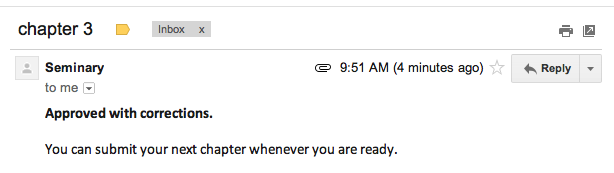
I opened an email account with Gmail in January of 2007.  In the past 19 months, not counting spam, I accumulated over 3200 emails (let’s see, that would be over 170 emails a month, 6-7 a day).  I know, I know, that’s a very modest number.  I know some people who deal with as many emails in a day as I see in a month.

But I succumbed to the Google mindset.  I told myself, “Self, your inbox has a terrific search feature, and no folders.  Don’t organize your email.”  In addition to that, for several months I used a desktop client to access mail from this account.  Hence, I lost all hope of ever seeing the final page of my inbox (at 50 per page, I’ll never get to 3257!).  Till today…

I used those fancy search features of Gmail (from:name in:inbox etc) to find and label mail, then I archived it as I labelled it.  Oh, and I deleted a lot too.  So now, my inbox of 3257 or so became an inbox of 1.  Supposedly that will increase my productivity.

I feel faster already.

Techie Things23 Jul 2008 09:43 am

I just stumbled across an amazing website – BibleMap.org!

Google Maps and Google Earth are pretty amazing; I’ll grant that.  I’ve taken coordinates from BibleWorks maps and ran them through Google Earth to get a better picture of locations and distances in Bible narratives.  That works.  But I’m reading Amos and there are over 20 cities/countries in the first chapter!  I need something faster.  Enter BibleMap.org.

Screenshot from BibleMap.org - Amos 1

Screenshot from BibleMap.org - Amos 1

Just go to BibleMap.org, choose your passage and voila!  The locations in that chapter are all tagged with little Google Map pointers and if you click the pointer, you get an encyclopedia article about the location.  Or, even easier, you can just click the colored name in the Scripture text and it’ll open the right map location tag for you!

Definitely a bookmarked site for me – thanks to the folks at HeLives.com for a great tool!

Devotional Thoughts &Hymn Gems20 Jul 2008 03:34 pm

I’ve been listening to King of Love today and the words to one of the songs reminded me of the great debt that Christ paid for me and the great freedom he provided!

Dark, the stain I cannot hide,
Stain of sin, my guilt to prove.
Guilt my own, and foolish pride,
Pride, the reason for my sin.

Light of God came shining down;
Son of God, my soul to win,
Laid aside His heav’nly crown,
Paid the price for all my sin,
Paid the price for all my sin.

Wash me in the Savior’s blood;
Make me pure without, within.
Cleanse my heart and set me free,
Free from guilt and free from sin,
Free from guilt and free from sin.

Love of God that lights my way,
Love displayed on Calvary;
Lamb of God my soul to save
Gave His life to set me free!

Gone, the darkness, come the Light;
Gone, the night, the day begins.
Gone, the wrong, my soul made right,
Free from guilt and free from sin,
Free from guilt and free from sin.

(“Free from Guilt and Free from Sin” by Don and Jaree Hall)

Devotional Thoughts19 Jul 2008 12:16 am

This morning the following paragraph in Whiter than Snow (Paul David Tripp) made me stop and think:

“Before you can ever make a clean and unamended confession of your sin, you have to first begin by confessing your righteousness.  It’s not just your sin that separates you from God; your righteousness does as well.  Because, when you are convinced you are righteous, you don’t seek the forgiving, rescuing, and restoring mercy that can be found only in Jesus Christ” (22).

How often (and sadly so) do we fail to seek needed forgiveness and restoration from the Lord – because we’re complacent in our over-estimation of our own supposed righteousness!  This brought to my mind a stanza of the hymn “Rock of Ages.”

Nothing in my hand I bring,
Simply to the cross I cling;
Naked, come to Thee for dress;
Helpless look to Thee for grace;
Foul, I to the fountain fly;
Wash me, Savior, or I die.

We usually don’t have a problem with admitting our naked, helpless condition when we’re first saved.  It’s easy to own the description of that hymn when giving a salvation testimony.  But … we need to claim that description far more often.  Foul sinners (even forgiven ones) still need to flee to the fountain for cleansing!  We must daily cast our dependence on God, confessing our nakedness and helplessness, begging for dress and grace, clinging to the cross with hands empty of our own righteousness, pleading for the Savior to wash us!

Christian Technology16 Jul 2008 11:12 pm

I’ve recently read a number of posts and blogs decrying Google (as a symbol of the internet) for how this new information medium is affecting us.  In one of those, Mark Ward asked about the relationship between that concern and Bible software.  Here is an [extremely] expanded version of a comment I posted on his site.  In fact, it’s mostly a new article.  I’ll put my initial comment into a blockquote later on…

“Is Google Making Us Stupid?”  This is the title of Nicholas Carr’s recent article on theAtlantic.com.  Because of its eye-catching title and mind-catching content, this article quickly spread across the blogosphere.  (Out of the 40 RSS feeds I read, at least 4 posts referenced the article; at least that many also wrote about Andrew Sullivan’s related post on TimesOnline.)  I personally found this quite ironic – an article is written warning us of the dangers of blog-cruising, hyperlink-flung web-skipping and the reaction: let’s all blog about it!

Carr and Sullivan raise valid concerns – namely, that the way we read and learn from the internet (and other electronic media) is affecting the way we think.  Their basic thesis is that that medium (the means) by which we obtain information affects the way we process that information (in other words, it changes how we think).  Carr offers both anecdotal evidence and research supporting this claim.  I’m inclined to agree and, frankly, it’s disconcerting.  I’ve seen this change in my mind to a degree.  On the one hand, I can read/skim through blog posts with ease but, on the other hand, I’m finding that I need to apply extra discipline when I sit down with a non-fiction book.

Carr lists (in balance of his warning) some other advances that met with similar resistance (like writing and the printing press).  While this concession is valid, Carr doesn’t give up on his main argument.  Rightly so.

And even more rightly so for the Christian.  I want to bring this warning out of the “internet culture” context and relate it to Christianity.  How do Christians respond to this apparent shift?

Why should we be concerned about this shift from print to electronic information (and its resultant thought change)?  God gave us the words he wanted us to have in a book.  Not a website, a blog or even a PDF.  A book.  From the commands to Moses (Ex. 17.14; 34.27) to John’s commission (Rev. 21.5), Scripture is written.  In fact, the word “scripture” refers to things that are written (both the English and the Greek – graphe).  The objection could be raised that Gutenberg’s press was a departure from “writing” in a rigid definition.  That’s true, but consider the history of the Bible.  In a fly-over pass, Scripture proper began with written scrolls (OT).  [Excursus: forgive another oral tradition clarification, but even when oral transmission may have played a part in the recording of God’s words, it is the "Scripture" (written word) that is inspired (II Tim. 3.16), not the word-of-mouth account.]  NT books were written on parchments.  These were copied by hand as needed.  Eventually, large groups of pages were bound (hand-written books).  With the coming of the press, duplication was greatly aided (both quality and quantity).  Chapter and verse numbers were added shortly thereafter.  Within a few centuries, print concordances were available.  And now, we have electronic copies of our Bibles (Hebrew, Greek, Aramaic and dozens of other languages) that we can read and search and sort and analyze.

So what?  Of all these changes, I see two that have significantly affected how we read the Bible.

First, the introduction of chapter/verse numbers made it easier to find a passage (especially in longer books!), but over time, I believe that this innovation has led to a change in the way Christians read their Bibles.  Simply put, we let artificial divisions control our interpretation.  A verse is a verse, so all I need to do is find one with the words I want and I can prove my point.  Unfortunately, we’ve allowed a helpful thing make it easier to misread (or not read) context.  I’m thankful for a recent trend toward verse-number-less Bible layout as in The Books of the Bible (Disclaimer – I appreciate the layout very much, but I am not endorsing the TNIV as a preferred translation).

Second, the advent of Bible software is altering the way that many approach their Bible.  In BibleWorks, I can pull up every use of the word “love” (Hebrew, Greek or English) in a matter of seconds and graph how the word is spread over individual books and chapters.  I can instantly find that passage that is escaping my recollection – simply by recalling one or two key words.  I can run analytical tools that examine contexts, thoroughly cull desired words and phrases and display the results in an easy-to-grasp way.  I have access to raw data that would have taken hours upon hours to acquire 250 years ago.  But am I reading my Bible better for it?

I would submit that there are some dangers to avoid in the use of Bible software.

One is the danger of subconsciously equating Google searches with word searches. We google a phrase and assume that we now have all the available information on the topic. Word studies of that depth are only part of the theological study – much more can be gained from concept studies. As much as I love BibleWorks7, nothing it offers comes close to reading and re-reading the passages under consideration for detail.

Another danger is the easy searchability that comes from electronic library materials (yes, that can be a danger!). A heavy reliance on “search function” research puts the reader in jeopardy of basing conclusions on snippets of others’ conclusions – without reading or understanding the work that went into their writing. It’s the danger of laziness – letting someone else do the analysis & synthesis and grabbing bits of their conclusions without bothering to check their data or process. (Plus, you learn a lot more when you are forced to read the other pages around the “necessary” portion of your commentary!)

Is there value in electronic Bible study materials?  Absolutely!  I rely heavily on BibleWorks7 and am eagerly anticipating a Logos purchase in the near future.  But the cautions are valid and necessary.  Software data gathering is never a substitute for reading the Bible.  Commentary-skimming is lazy and precarious.  If God wanted us to read Scripture as a collection of word searches, he wouldn’t have given us a book full of narratives and sermons and letters and songs!  Further, we’ll never google our way out of theological tension – God allows that to keep us humble (among other reasons).  Note Carr’s warning: “In Google’s world, the world we enter when we go online, there’s little place for the fuzziness of contemplation. Ambiguity is not an opening for insight but a bug to be fixed” (from “Is Google Making Us Stupid?“).

We must not glorify technological advances and research tools and search functions and portable libraries while “what we may be losing is quietness and depth in our literary and intellectual and spiritual lives” (from “Google is giving us pond-skater minds” by Andrew Sullivan).

I’m going to go read a book now.

Life in General14 Jul 2008 02:11 pm

I enjoyed a hike a week ago at Caesar’s Head State Park – some friends from church and I hiked about 11 miles along a few of the beautiful trails there.  We hiked to Raven Cliff Falls (strenuous trails!) and along the Naturaland Trust Trail.  The trails have some copperheads – we’re very thankful for the Lord’s protection during this hike.

Here are some photos from the hike.

Devotional Thoughts14 Jul 2008 11:37 am

At least the right kind of laughter.

In a recent sermon, CJ Mahaney makes the point that what we laugh at reveals our pride/humility.  If we, on the one hand, are quick to laugh at others’ humiliations, there is pride behind that; if on the other hand, we are quick to laugh at ourselves (self-deprecating humor, he calls it), that’s evidence of humility.

In his book on humility, Mahaney quotes Terry Lindvall on this subject: “A proud man cannot laugh because he must watch his dignity; he cannot give himself over to the rocking and rolling of his belly.  But a poor and happy man laughs heartily because he gives no serious attention to his ego” (94-95).

Next Page »